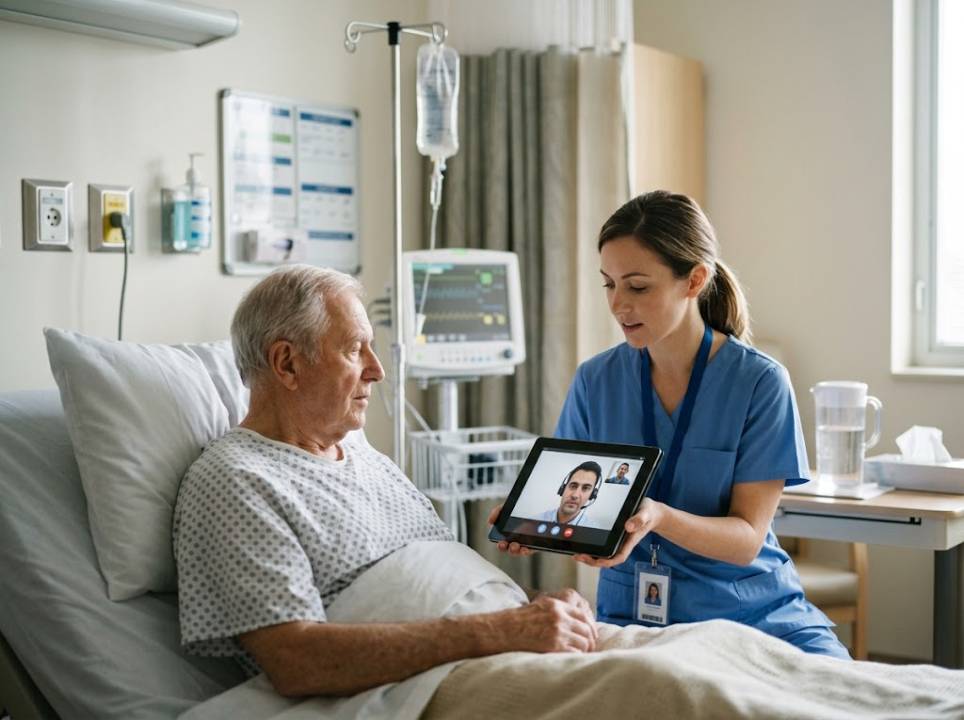
A patient arrives in the emergency department speaking only Tigrinya. Another needs to sign consent for surgery but uses British Sign Language. A third is an elderly man whose Cantonese is fluent but whose English is limited. In each case, clinicians need to communicate accurately and quickly. Finding an interpreter who can come in person may take hours, or may simply be impossible at three in the morning.
Video remote interpreting, often called VRI, connects clinicians and patients with professional interpreters through a screen in seconds. It has become one of the most important tools in modern interpreting services for healthcare.
How video remote interpreting works
The clinician opens an app on a tablet, laptop or dedicated cart, selects the language and is connected to a qualified interpreter. The interpreter appears on screen, sees and hears both parties and interprets the conversation in real time, usually consecutively. When the conversation ends, the call is closed. Some systems also log the language, duration and interpreter ID for audit purposes.
Compared with phone interpreting, video adds visual cues: facial expressions, gestures and the ability to see documents or demonstrations. Compared with in person interpreting, it is faster to arrange and often more cost effective for short encounters.
When VRI works best
- emergency and urgent care where speed matters;
- routine consultations and follow up appointments;
- medication reviews and discharge explanations;
- rare languages where no local interpreter is available;
- night shifts, weekends and remote locations.
When in person interpreting is better
Video is not always the right choice. Delivering a serious diagnosis, end of life discussions, mental health assessments, sessions with children or patients with cognitive impairments, and situations where the patient cannot see or hear the screen well may call for an interpreter in the room. Good practice is to choose the mode that serves the patient, not just the schedule.
Quality and qualifications
Medical interpreting requires specific training. Interpreters must know medical terminology, follow a code of ethics, maintain confidentiality and stay neutral. They interpret everything that is said, without adding, omitting or softening. When choosing a VRI provider, ask how interpreters are qualified, how they are tested in medical settings and how quality is monitored.
Accessibility and legal duties
In many countries, healthcare providers have legal duties to ensure effective communication with patients who have limited proficiency in the local language or who are deaf. In the United States, for example, guidance on effective communication under disability law is published on ADA.gov. UK and European providers have comparable obligations under equality and patient rights legislation.
Written information after the call
Conversations are only part of the picture. After a consultation, patients often receive discharge letters, medication instructions or consent forms. If they cannot read them, the benefits of the interpreted conversation fade quickly. Professional medical translation services can prepare key documents in the patient's language. When records need to be shared with insurers or authorities abroad, official translation services provide certified versions.
Hospitals that plan for written follow up alongside video interpreting get better continuity of care, since patients take discharge letters and medication instructions home with them. Specialist medical translation services prepare these documents in plain, accurate language reviewed for clinical settings. When written materials match the quality of the interpreted conversation, patients are far more likely to follow treatment correctly.
Setting up VRI well
Technology alone does not guarantee good communication. Successful programmes pay attention to details: reliable Wi Fi in every ward, devices that are charged and cleaned, good audio with headsets or speakers, privacy screens, and clear instructions for staff. Short training sessions help clinicians learn to speak in short segments, address the patient directly and check understanding.
Privacy and security
VRI platforms handle sensitive health conversations. They should use encrypted connections, avoid storing recordings unless required, and comply with relevant health data regulations. Interpreters should work from private, quiet locations with secure equipment.
Sign language interpreting
Video remote interpreting is especially valuable for deaf and hard of hearing patients who use sign language. Unlike phone interpreting, video allows the interpreter to see and produce signs, facial expressions and body language, all of which carry meaning in sign language. Hospitals should make sure screens are large enough, lighting is good and the camera is positioned so the patient and interpreter can see each other clearly. In some situations, such as complex consultations or patients with additional needs, an on site sign language interpreter remains the better option.
Legal frameworks in many countries require healthcare providers to offer effective communication for patients with disabilities, which makes planning for sign language access part of good practice rather than an optional extra.
Measuring success
Hospitals that introduce video interpreting should track how often it is used, how long connections take, which languages are requested and how staff and patients rate the experience. These figures reveal gaps, such as languages with long wait times, and help managers decide where on site interpreters or additional training are needed.
Training staff
Even the best technology fails if staff do not know how to use it. Short, practical training sessions, quick reference cards and champions on each ward make video interpreting part of everyday routine.
Final thoughts
Video remote interpreting puts a qualified interpreter within reach of every bedside, at any hour. Used thoughtfully, alongside in person interpreters and translated written materials, it helps healthcare teams provide safe, respectful care to every patient, whatever language they speak.